
Heritage & Architectural Wonder
Bhimkund, Madhya Pradesh : A Complete Travel Guide
Madhya Pradesh is home to some of the most fascinating natural and historical wonders in India.
 By Spiritual Yatra
11 min read
By Spiritual Yatra
11 min read

Bhimkund, Madhya Pradesh: A Complete Travel, Hydrological, and Mythological Guide
Introduction and Geographical Duality
Madhya Pradesh is home to some of the most fascinating natural and historical wonders in India. For travelers planning a journey to this central Indian state, understanding regional geography is key to avoiding travel confusion. In particular, the name "Bhimkund" (or Bheemkund) refers to two distinct destinations within Madhya Pradesh, each offering a completely different experience.
The most famous Bhimkund is a sacred, deep-blue karst cave pool located near Bajna village in the Chhatarpur district of the Bundelkhand region. This natural water tank is renowned for its mystical depth and its association with the Hindu epic, the Mahabharata.
The second site, also named Bhimkund (often paired with Churna), is situated within the dense forests of the Satpura Tiger Reserve near Pipariya and Pachmarhi. This southern site is primarily a wildlife and eco-tourism destination requiring forest permits and safari vehicles.
Travelers should also note that a third, unrelated Bhimkund exists as a scenic waterfall and tourist spot in the state of Odisha, which should not be confused with either of the Madhya Pradesh locations. This guide focuses primarily on the legendary cave pool of Chhatarpur while providing transitional context and logistics for both Madhya Pradesh sites to ensure seamless travel planning.
|
Destination |
Geographic Coordinates |
Primary Attraction |
Essential Traveler Requirements |
|
Bhimkund (Chhatarpur) |
24.438476° N, 79.376122° E |
Deep-blue karst cave pool, ancient temples, and religious pilgrimage. |
Open public access; modest dress; no entry fee or permits required. |
|
Bhimkund (Satpura) |
Located within Satpura Tiger Reserve near Churna |
Wilderness exploration, wildlife spotting, and eco-resorts. |
Forest department permits; guided safari vehicles; planned lodging. |
Geological Structure and Hydrological Phenomena
To geologists and nature enthusiasts, the Chhatarpur Bhimkund is a remarkable example of karst topography. Scientifically, the pool is classified as a collapse doline—a natural sinkhole formed when an underground cave ceiling collapses to reveal a water-filled chamber below. The site sits at an altitude of 480 meters above sea level. The collapsed surface opening is nearly circular with a diameter of 15 meters, while the cavern itself expands to a width of 20 meters and a length of 50 meters.
The rock formations surrounding the pool belong to the Proterozoic Bijawar Group, specifically a local carbonate rock layer known as the Bajna Dolomites, which extends about 60 kilometers from Hirapur to Bijawar. This dolomite is overlaid by the younger Vindhyan Supergroup. While dolomite is typically white or grey, the rock walls inside the Bhimkund cave exhibit rich shades of pink, brown, and reddish-brown due to high iron content.
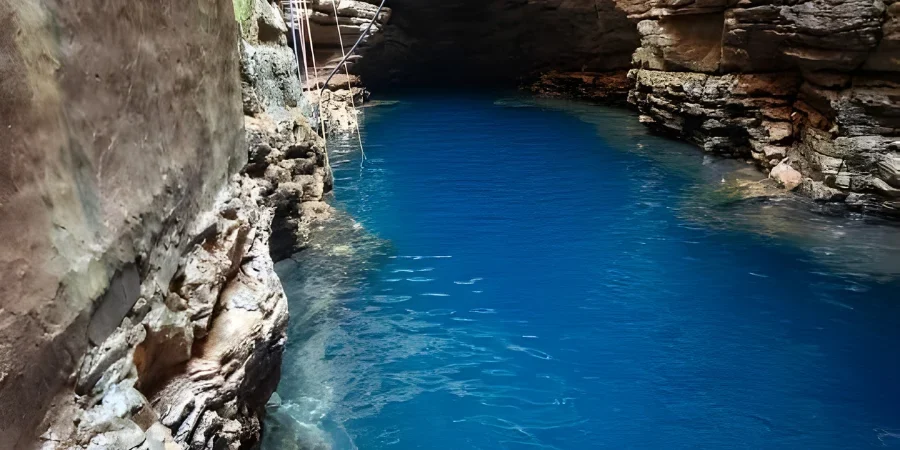
The water in the pool is a deep indigo and turquoise blue, presenting a striking contrast to the red-toned cave walls. This vibrant color is a natural optical phenomenon caused by the extreme depth of the pool and the high limestone and mineral content of the water, which scatters light in a manner similar to marine sea caves. A large natural opening in the cave ceiling directly above the pool allows sunlight to filter in, creating a spotlight effect that illuminates the water and produces shifting rainbow-like patterns on the cave walls throughout the day.
The water is so transparent that travelers can clearly see fish swimming near the surface before the light fades into the deep blue.
|
Hydrological Feature |
Scientific Reality & Observations |
|
Water Transparency |
Crystal clear; active, moving aquifer replaces dirty water with fresh water. |
|
Pumping Resistance |
Pumping tests failed to lower the water level; water is replaced faster than pumps can extract it. |
|
Flow Pattern |
Divers discovered two large underwater holes; water continuously flows in from one and exits through the other. |
|
Underwater Currents |
Strong lateral water currents are documented at a depth of 80 feet, pointing to horizontal cave conduits. |
|
The Disappearing Body Phenomenon |
Drowning victims pull deep into the horizontal cave passages due to currents, failing to float back to the surface. |
The water of Bhimkund is believed by locals to have healing properties and is considered highly pure, remaining fresh without deteriorating over long periods. Many travelers compare its mineral quality to Himalayan spring water, and visitors frequently collect it in bottles to take home.
Mythological Foundations and Subterranean Sacred Architecture
The cultural significance of the Chhatarpur Bhimkund is deeply tied to sacred Hindu legends. The most prominent story comes from the Mahabharata, which dates back thousands of years. During their twelve-year exile, the five Pandava brothers and their wife, Draupadi, were wandering through the hot, dense forests of Bundelkhand. Overcome by the scorching heat, Draupadi fainted from extreme thirst.
Yudhishthira, the eldest brother, urged Nakul to use his unique divine abilities to locate water deep within the earth. After Nakul meditated and pointed to a spot, Bhima, the strongest of the brothers, struck the rocky ground with his Gada (iron mace). The impact cracked the earth, creating a deep opening that revealed water 30 feet below the surface. To help Draupadi reach the pool, Arjuna used his archery skills to shoot arrows into the stone walls, creating a flight of steps.
Travelers visiting the cave can observe two features that locals associate with this legend: the circular hole in the cave ceiling, which is said to be the entry point where Bhima's mace struck the stone, and the rough steps leading down the cave walls.
A secondary legend connects the pool to the celestial sage Narada. It is said that Narada performed the Gandharva Gaanam (celestial song) to praise Lord Vishnu. Pleased by Narada's devotion, Lord Vishnu emerged from the waters. His dark, blue-skinned form (often associated with his avatar, Krishna) permanently colored the waters a deep indigo, giving rise to the names Neel Kund (Blue Pool) and Narada Kund. Another Vaishnavite belief holds that Lord Vishnu once appeared as a giant tortoise and rested at the bottom of the pool.
Over generations, this natural cave has been modified to accommodate religious pilgrims and travelers. Today, visitors enter through a simple, whitewashed concrete facade built into a shallow surface depression. Inside, three concurrent flights of tiled steps descend approximately 13.3 vertical meters (40 walking meters) down to the water's edge.
The northern and northeastern cave walls above the pool feature a double-storeyed concrete facade with pillared entrances leading to distinct chambers :
- The Primary Shiva Temple: This irregularly angled room houses a highly revered, polished sandstone Shivalinga set in an artistic yoni. The plastered back walls contain small niches for devotional offerings.
- The Pilgrim Mandapam: An adjacent room serves as a rest area or dormitory for visitors. It features a less artistic Shivalinga made from an un-worked, elongated rock on a concrete plinth, a fireplace, barred windows, and a basic electrical setup.
- The Hilltop Shivalinga: On the hill directly opposite the cave pool, travelers can also view a natural rock formation that closely resembles a Shivalinga.
Taking a holy bath in the pool, particularly during the winter harvest festival of Makar Sankranti (January 14–15), is believed to cure physical ailments and wash away sins.
Scientific Anomalies: Seismic Responses and the Saraswati Connection
While the religious legends draw thousands of pilgrims, Bhimkund also attracts geologists due to several documented scientific anomalies. The most famous of these is the pool’s reaction to distant seismic activity. Although Bhimkund is completely landlocked in the dry hills of central India, it serves as a natural early warning system for major disasters.
During the devastating Indian Ocean Tsunami of December 2004, the water level in Bhimkund suddenly surged by 30 feet, creating ten-foot tides that rose from the depths. Similar dramatic rises in the water level have been documented during other major natural disasters, such as the Nepal earthquake. Geologists theorize that these reactions prove the pool is connected to a vast, deep-seated underground fracture network that links directly to far-away oceanic plates.
This connection to a larger subterranean highway is supported by a well-known local experiment. According to regional accounts, a monk once carved distinct markings on a wooden stick and dropped it into the depths of Bhimkund. Months later, the exact same stick was reportedly pulled from the Yamuna River at the Triveni Sangam in Prayagraj, nearly 300 kilometers away.
This trajectory matches modern geological theories. Geoscientists suggest that the high-pressure underground network feeding Bhimkund is a physical remnant of the ancient, legendary Saraswati River, which is traditionally described as flowing invisibly beneath the earth. The Mahabharata story of Bhima cracking the earth to reveal water may be a historical memory of ancient people witnessing the sudden opening of this hidden, high-pressure aquifer.
Practical Traveler's Logistics and Accommodations
For travelers planning a trip to Bhimkund, timing and transportation require careful preparation, as the Chhatarpur site is located in a relatively remote area. The most convenient travel strategy is to use the town of Khajuraho as a primary base. Khajuraho is a major tourist hub famous for its UNESCO World Heritage temples and offers excellent air, rail, and road connections. Alternatively, Chhatarpur town, located 77 kilometers away, offers a closer but more basic option for travelers.
|
Travel Aspect |
Chhatarpur Bhimkund (Cave Pool) |
Satpura Bhimkund (Wildlife Reserve) |
|
Best Time to Visit |
October to March (pleasant weather). Avoid July and August when heavy rains can flood local Bundelkhand roads. |
October to June (jungle safari season). Closed during peak monsoon months. |
|
Optimal Time of Day |
Arrive before noon. The overhead sun shines directly through the ceiling opening, highlighting the blue water. |
Early morning or late afternoon for scheduled wildlife safaris. |
|
How to Reach by Air |
Fly to Khajuraho Airport (HJR), then hire a private cab for the 80–92 km road journey (~2 hours). |
Fly to Raja Bhoj International Airport (BHO) in Bhopal, then take a cab or bus. |
|
How to Reach by Train |
Khajuraho Railway Station (direct trains to Delhi, Varanasi, and Bhopal). Private cabs from the station cost Rs 1,200–1,800. |
Pipariya Railway Station is the nearest hub, well-connected to major Indian cities. |
|
How to Reach by Road |
Accessible via Highway 34 (between Chhatarpur and Sagar), turning onto Highway 46 towards Hatta, then turning left near Bajna village. |
Well-connected by road from Bhopal, Pipariya, or Pachmarhi. |
Because there are no commercial lodging options directly at the Chhatarpur Bhimkund site, travelers must plan to stay in either Chhatarpur or Khajuraho.
|
Hotel Name |
Location |
Category & Key Amenities |
|
The Oberoi Rajgarh Palace |
Khajuraho / Rajnagar |
Luxury; exceptional service; set in a beautifully restored historic castle. |
|
The Lalit Temple View |
Khajuraho |
Luxury; temple views; premium amenities and fine dining. |
|
Radisson / Ramada |
Khajuraho |
Mid-range; clean rooms; swimming pool, helpful staff, and peaceful surroundings. |
|
Syna Heritage / Hotel Chandela |
Khajuraho |
Mid-range; historical charm; comfortable gardens and reliable services. |
|
Hotel Ratan Palace |
Chhatarpur |
Budget-friendly; 5-star local rating; city views, 24-hour service, and free Wi-Fi. |
|
Hotel Jatashankar Palace |
Chhatarpur |
Budget-friendly; 3-star standard; highly rated local breakfast and central location. |
|
Hotel 7-B |
Chhatarpur |
Budget-friendly; comfortable rooms; complimentary local breakfast and free Wi-Fi. |
|
Hotel Lakeview |
Chhatarpur |
Budget-friendly; features private rooms with kitchens, a garden, and a daily breakfast. |
Traditional Bundelkhand Cuisine Guide
Sampling the local food is an essential part of the travel experience in Bundelkhand. Bundeli cuisine is traditionally simple, rustic, and predominantly vegetarian, heavily influenced by historical Jain culinary practices. The dishes utilize locally grown grains like wheat, millets, sorghum, and chickpea flour (besan), cooked with pure ghee, mustard oil, and simple spices.
Because dining options are limited to basic stalls near Bajna village, travelers should look for these traditional dishes at local eateries in Chhatarpur or Khajuraho :
|
Dish Name |
Type |
Description and Key Ingredients |
|
Bara |
Savory / Festive |
Deep-fried split black lentil (udad dal) dumplings soaked in spiced buttermilk, tempered with mustard seeds, and served with a sprinkle of sugar. |
|
Maheri |
Main / Light Meal |
A comforting, porridge-like dish made of broken wheat (dalia) or crushed millet slow-cooked with buttermilk. |
|
Meeda |
Curry / Gravy |
Tiny roasted chunks of gram flour (besan) simmered in a light, spiced tomato-and-onion-based gravy. |
|
Besan ke Aaloo |
Dry Main |
Small, lemon-sized balls of chickpea flour mixed with roasted dry gooseberry (amla) powder, boiled, cut, and sautéed in pure ghee with local spices. |
|
Thopa |
Savory Snack |
A thick paste of chickpea flour cooked with garlic, onions, chilies, and cumin, flattened on a plate, cooled, and cut into diamond-shaped pieces. |
|
Bafauri (Baffori) |
Side / Snack |
Light, steamed dumplings made from a thick batter of chickpea flour cooked over an earthen pot on a cloth screen, then tossed with mild spices. |
|
Karar |
Curry / Gravy |
A rich, kadhi-like gravy made from coarsely ground, soaked green gram (mung dal) cooked with buttermilk and spices. |
|
Fara (Peetha) |
Dumpling |
Savory steamed cylinders made of wheat or rice flour, stuffed with a spiced mixture of soaked chana dal, garlic, and green chilies. |
|
Ras Kheer |
Dessert |
A sweet, seasonal pudding prepared during the sugarcane harvest, made of fresh sugarcane juice, rice, milk, and local mahua flowers. |
|
Lapsi |
Dessert |
A wholesome sweet dish made of broken wheat (dalia) roasted in pure ghee, sweetened with jaggery, and garnished with dried fruits. |
For street food, travelers visiting the markets near the Western Group of Temples in Khajuraho can also try chironji barfi (a sweet made of condensed milk and local nuts) and ghol (a mixture of dried fruits, ghee, and jaggery).
Safety, Conservation, and Nearby Attractions
To ensure a safe and respectful visit to the Chhatarpur Bhimkund, travelers should keep several practical tips in mind. Because Bhimkund is an active place of worship, visitors must dress modestly and remove their footwear before entering the temple areas inside the cave.
While swimming in the cool blue waters is permitted under local supervision, travelers must exercise extreme caution. The cave floor can be slippery, and the strong underwater currents at deeper levels make solo diving highly dangerous.
Additionally, because there are limited commercial facilities near Bajna village, it is highly recommended to carry bottled drinking water and light snacks for the road.
Beyond the cave pool itself, the surrounding region offers several excellent activities for nature lovers and adventure seekers :
- Wildlife Spotting in Bajna Forest: The dense forests surrounding the cave are home to diverse local wildlife, including deer, monkeys, and peacocks.
- Local Trekking: Travelers can take scenic walks through the rugged hills to visit the Bhima Devi temple, as well as nearby historical temples dedicated to Lord Hanuman and Lord Shiva.
- Regional Integration: A visit to Bhimkund can be easily planned as a day-trip excursion combined with a wildlife safari at Panna National Park or a scenic stop at the spectacular Pandav Falls and Caves. Travelers can easily arrange this itinerary through hotels or transport providers in Khajuraho.
Keep Reading
View All Articles-
The Ajanta Cave Murals: India's Finest Early Buddhist Art
Buddhism found its earliest and most beautiful artistic expression at the Ajanta Caves in Maharashtra, India.
-
Padmanabhaswamy Temple: Mystery of Secret Vault B
Uncover the wealth and mysteries of Kerala's Padmanabhaswamy Temple. Learn about the untouched secret Vault B sealed by ancient Naga Bandham
-
The Great Kailash Temple of Ellora
Deep within the rocky embrace of the Charanandri Hills in Maharashtra, India, lies a monument that challenges the boundaries of human imagination and ancient engineering.