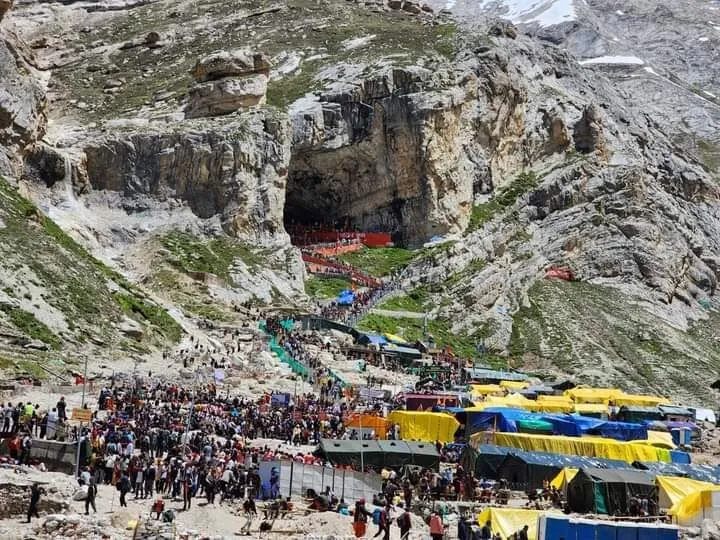
The annual Amarnath Yatra is a profound manifestation of India's syncretic and inclusive culture, blending religious fervor, secular ethos, and the extraordinary endurance required to traverse the high-altitude terrain of Jammu and Kashmir. Situated at the head of the Sind Valley to the north of Anantnag at an imposing altitude of 12,723 ft, the sacred Amarnath Cave is flanked by the Great Himalayan Range to the north and the Sachkach (Sasakat) Mountains to the south.
For pilgrims making the ascent, the arduous trek is not deterred by a lack of basic sanitation, physical exhaustion, or elevations exceeding 14,000 ft encountered along the way. Instead, travelers stride upward both physically and metaphorically to witness the world's only natural ice linga and experience a journey of deep spiritual awakening.

1. Legends, Mythology, and Spiritual Significance
The Immortal Lord and the Amar Katha
Inside the Amarnath Cave, a pure white ice-mound forms as water trickles down drop by drop from the roof—believed to originate from the holy Ramkund Lake situated above the cave. This mound forms a perfectly shaped swayambhu linga that waxes and wanes with the phases of the moon, reaching its full height on the nights of the full moon in the auspicious month of Shravan (August).
According to Hindu mythology, this is the sacred spot where Lord Shiva narrated the Amar Katha (the secret of immortality) to his consort Parvati:
-
The Journey of Renunciation: Seeking a lonely place where no living being could overhear, Shiva traveled toward the cave, shedding worldly attachments along the way:
-
-
- Left his bull, Nandi, at Pahal-gam (Bailgaon).
- Released the moon from his locks at Chandanwari.
- Forsook the snakes around his neck by the banks of Lake Seshnag.
- Left his son Ganesh behind at Mahagunas Parvat (Mahaganesh Hill).
- Left behind the Panchabhoota (Earth, Water, Air, Fire, and Sky) at Panchtarni.
-
- The Immortal Pigeons: Upon arriving at the cave, Shiva seated himself upon a deerskin and created Kalagni (fire) to destroy all living things nearby. Unbeknownst to him, a pair of pigeon eggs lay unharmed beneath the deerskin. Born from the eggs after hearing the secret of creation, the pair became immortal. To this day, pilgrims frequently spot pigeons residing on the roof of the cave as their eternal abode.
Seshnag Lake and Panchtarni
- Seshnag Lake: Symbolizing the cosmic ocean where Lord Vishnu reclines, Seshnag Lake is surrounded by mighty, untouched peaks. It is considered highly auspicious to bathe in its icy waters.
- Panchtarni: In these plains, Shiva danced the tandava in such ecstatic immersion that his locks were undone, causing five streams of the Ganga to fall to the ground, forming the Panchtarni.
2. A Brief History and the Sacred Chhari Mubarak
Historical References
The Amarnath Cave is documented extensively in ancient texts including the Bhrngish Samhita, Nilmat Purana, Kalhana’s Rajtarangini, and the Mahatmayas of Amarnatha and Amreshvara Kalpa. Historical figures ranging from King Samdimat (34 BCE–17 CE) and Muslim ruler Zain-ul-abdin (1420–70) to French physician Francois Bernier (1663) and traveler G.T. Vigne (1842) have recorded visits to or observations of the cave. In 2000, management of the shrine was taken over by the state government and is currently governed by the Shri Amarnathji Shrine Board headed by the Governor of Jammu and Kashmir.
Chhari Mubarak (Shiva’s Silver Mace)
The yatra is anchored by the Chhari Mubarak, the holy silver mace representing Shiva’s mystical powers. According to the Bhrngish Samhita, Shiva gave the chhari to Rishi Kashyap with the command that it be carried to Amarnath each year.
- The Procession: The yatra commences with ceremonies at the Dashnami Akhara in Budshah Chowk, Srinagar, led by Mahant Deepender Giri.
- Milestones: Before reaching the cave on Raksha Bandhan, the Chhari Mubarak visits the Shankaracharya Temple, Sharika Bhawani Temple, Durganag Temple, Sureshwar Temple, and ancient sites in Pampore, Bijbehara, and Mattan (Martand-Tirth).
- Culmination: Accompanied by a religious congregation, the mace is brought to the holy cave on Raksha Bandhan for pujan, and later immersed (visarjan) in the Lidder River at Pahalgam.
3. The Routes to the Holy Cave
There are two primary trekking routes to reach the Amarnath Cave:
Route A: The Pahalgam Route (The Traditional & More Sacred Route)
- Itinerary: Pahalgam / Nunwan → Chandanwari (16 km) → Pissu Top (3 km) → Seshnag (9 km) → Panchtarni (13 km) → Amarnath Cave (6 km). Duration: 2–6 days.
- Terrain & Challenges: From Chandanwari, the track becomes extremely steep, accessible only on foot, pony, or dandi (palki). Key physical hurdles include:
-
- Pissu Ghati (10,403 ft): A terribly steep 3-km ascent symbolizing that the path to salvation involves superhuman struggle.
- Mahagunas Top / Wawjan (15,091 ft): A formidable 6-km climb from Seshnag representing the highest point of the route, where pilgrims cross over from the Lidder Valley into the Sind Valley.
-
Night Halts: Available at Pahalgam (Nunwan base camp), Seshnag, and Panchtarni.
Route B: The Baltal Route (The Shorter Route)
- Itinerary: Baltal → Domail (2 km) → Burari Marg (5 km) → Sangam Ghati (5 km) → Amarnath Cave (3 km).
- Characteristics: Shorter in distance but significantly steeper and more prone to landslides. There is no overnight accommodation between Baltal and the holy cave, meaning fast pilgrims can attempt a grueling one-day return if weather permits, though most camp in tents near the cave.
4. Inside the Amarnath Cave
Approaching the final kilometer, pilgrims travel over solid ice through a deep ravine facing south.
- Dimensions: The outer mouth is approximately 40 yards across, about 75 ft high, and at least 80 ft deep.
- The Deities: Inside sits the central ice linga rising to about 7 ft, flanked to its right by a 6-ft block of ice revered as Ganesh and a smaller ice figure representing Goddess Parvati.
- Vibhuti & Water: A small secondary cave to the right of the Shivaling provides a chalk-like substance collected as sacred vibhuti (ash) and holy water.
- Preservation Debates: Due to body heat and camera flashes from hundreds of thousands of annual visitors, the ice linga often melts ("goes into relaxation") prematurely, sparking ongoing debates over artificial cooling, visitor caps, or viewing the linga from a safer distance.
5. Multicultural Ethos and Community Support
The Amarnath Yatra stands as a shining example of Indian multiculturalism. While deeply sacred to Hindus, the operations rely heavily on local Kashmiri Muslims:
- Organization & Support: Many members of the Shrine Board, local pony-men, luggage carriers, tent owners, and approximately 200 makeshift shop owners along the route are Muslim, taking immense pride in supporting the pilgrimage.
- Langars (Community Kitchens): Around 100 volunteer groups (Shiva sevak mandals) from states like Gujarat, Rajasthan, UP, Delhi, Haryana, and Punjab set up elaborate temporary kitchens along the route, offering free, high-quality vegetarian meals (paranthas, milk, rice, sweets, dal, and tea) and basic medication.
6. Comprehensive Fact File & Practical Tips
Registration and When to Go
- Timing: Traditionally open from early July (Ashad Purnima) to early August (Shravan Purnima), concluding on Raksha Bandhan. Duration has expanded in recent years to 45–60 days starting from Vyas Purnima.
- Registration: Pilgrims are advised to register in advance through designated branches of Jammu and Kashmir Bank Ltd (or via
jkbank.net), which requires submitting a medical fitness certificate and obtaining a yatri permit.
Security Arrangements
A robust, multi-layered security blanket is deployed across the route:
- The Army mans high mountain altitudes to prevent infiltration.
- The Border Security Force (BSF) dots the trekking trail.
- The Central Reserve Police Force (CRPF) manages night-halt camps, which are heavily fortified with barbed wire, iron gates, and round-the-clock sharpshooters.
Essential Guidelines for Pilgrims
-
Physical Fitness: Because the yatra involves extreme altitudes up to 14,000+ ft, start preparatory exercises (brisk walking 4–5 km daily) and breathing exercises like Pranayama at least a month prior.
-
Packing List: Pack essential woollens, windcheaters, raincoats, waterproof shoes with strong grips, a flashlight, walking sticks, a monkey cap, gloves, and a personal medical kit containing painkillers and cold medicine.
-
Prohibitions: Smoking and consuming alcohol are strictly prohibited. Meals served along the route are strictly vegetarian.
-
Logistics & Rates: Hire only government-registered porters and ponies. Avoid paying more than government-fixed rates for ponies, dandis, and accommodation.
-
Environmental Care: Do not use disposable plastics around base camps or trekking paths to protect the pristine mountain ecosystem.

The platform is read by seekers across 24 countries and is hosted in India. Its tone is warm yet dignified, ancient yet contemporary, and deeply respectful of the reader’s inner journey. Spiritual Yatra is more than a website - it is a digital ashram of sorts: a calm, high-quality space where every soul’s sacred story is honored. It invites you to slow down, reflect deeply, and walk the path with greater awareness and care. Whether you’re looking for daily wisdom, profound teachings from the Upanishads, or simply a place that feels like a quiet companion on your spiritual journey, Spiritual Yatra offers something rare in today’s digital world: depth, sincerity, and gentleness. “Every soul has a sacred story.” This is where that story is welcomed and held with reverence.