






Heritage & Architectural Wonder
Kirtimukha at Kedarnath Temple
The carved face positioned above the main entrance doorway of Kedarnath Temple in Uttarakhand is widely identified in popular devotional media as Kirtimukha
 By Spiritual Yatra
11 min read
Kirtimukha and the Kedarnath Temple: Iconography, Myth, and Architectural Evidence
The carved face positioned above the main entrance doorway of Kedarnath Temple in Uttarakhand is widely identified in popular devotional media as Kirtimukha the fierce, lion-like "Face of Glory" born from Lord Shiva's wrath though primary archaeological and architectural documentation does not confirm this attribution. No published Archaeological Survey of India (ASI) survey, official temple committee documentation, or peer-reviewed architectural monograph verifies a Kirtimukha sculpture on Kedarnath's facade. Popular heritage commentary characterizes the carving as an "enigmatic face" whose meaning remains unresolved among theories linking it to a guardian deity or Adi Shankaracharya, whereas standard reference overviews and architectural summaries omit any mention of a Kirtimukha above the entrance.
Because Kirtimukha is an established protective motif across North Indian Nagara architecture and Himalayan stone temples documented at sites such as Dwarahat in Uttarakhand and Bajoura in Himachal Pradesh understanding the carving at Kedarnath requires examining both the verifiable architectural history of the shrine and the broader Puranic, iconographic, and Vastu traditions of the motif. Distinguishing the exterior doorway carving from other sacred "head" and guardian traditions tied to Kedarnath including a human head carved on the inner sanctum's triangular lingam, the winter protector Bhukund Bhairavnath, and Nepal's Kirtimukh Bhairav and Doleshwor Mahadev traditions further clarifies how popular devotion and regional art history intersect at the shrine.
Evidentiary Status of the Entrance Carving at Kedarnath
Descriptions of the carving above Kedarnath Temple's doorway diverge sharply across source types. Short-form devotional videos assert directly that the head placed above the entrance door is Kirtimukha, retelling the story of Lord Shiva opening his third eye in anger to generate a fierce demon. By contrast, general architectural and travel commentary highlights an unusual "enigmatic face above the entrance" that is absent from the other four Panch Kedar shrines (Tungnath, Rudranath, Madhyamaheshwar, and Kalpeshwar) yet mirrored at the Kalp Kedar Temple in Uttarkashi. Rather than offering a definitive identification, this commentary notes competing theories that the face depicts either a guardian deity or Adi Shankaracharya.
Authoritative reference overviews and academic summaries are notably silent on the motif. Neither Encyclopaedia Britannica nor encyclopedic architectural summaries of Kedarnath record a Kirtimukha above the doorway. Britannica notes only that the temple's walls bear carvings of deities, mythological scenes, and floral motifs, with a stone statue of Nandi positioned at the entrance. Similarly, devotional temple guides mention intricate floral scrolls, deities, and celestial attendants on the entrance doorframe without naming a Kirtimukha, and a 2025 architectural study of the Char Dham shrines describes Kedarnath's plan and floral wall niches without cataloging a doorway mask. Identifying the Kedarnath entrance face specifically as Kirtimukha therefore rests on popular visual interpretation and broader Himalayan temple conventions rather than formal epigraphic or ASI records.

| Source Type | Identification of Kedarnath Entrance Carving | Key Details and Evidentiary Limitations |
| Devotional social media videos |
Kirtimukha |
Identifies the head above the door as the being born from Shiva's third eye; provides no archaeological or epigraphic source. |
| Popular architecture and travel blogs |
"Enigmatic face" (guardian deity or Adi Shankaracharya) |
Notes absence at other Panch Kedar temples and a parallel at Kalp Kedar in Uttarkashi; treats the identity as an open mystery. |
| Reference overviews (Britannica, Wikipedia) |
Not mentioned |
Describe deity and floral wall carvings, mandapa statues, and a head carved on the triangular lingam itself, rather than on the doorway. |
| Devotional temple guides and academic summaries |
Floral scrolls, deities, celestial attendants, floral niches |
Document general doorframe and wall ornamentation without attributing a Kirtimukha. |
Architectural Context of Kedarnath and Himalayan Stone Temples
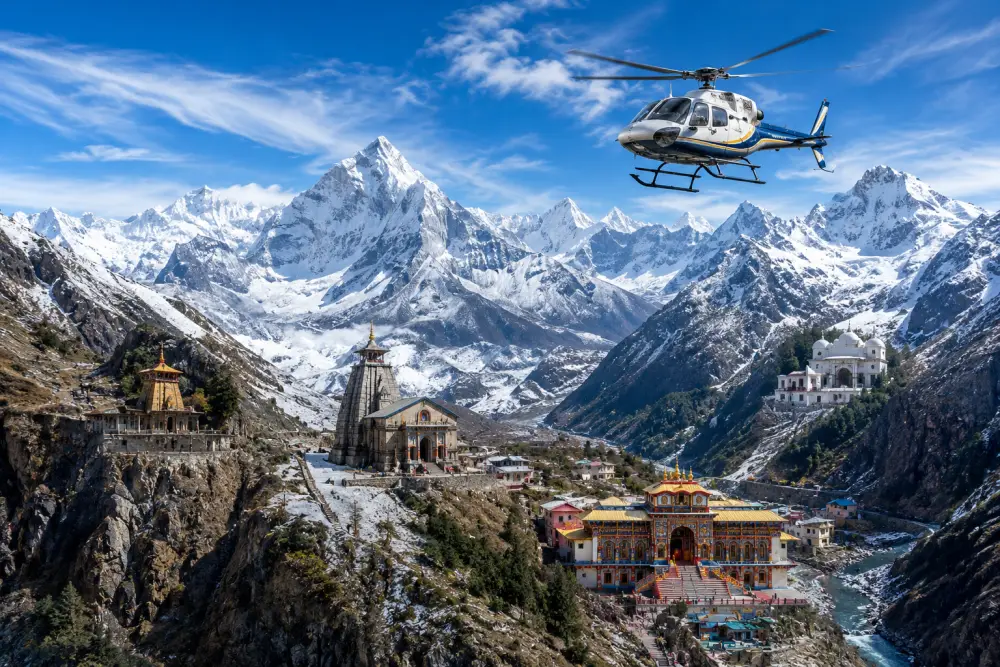
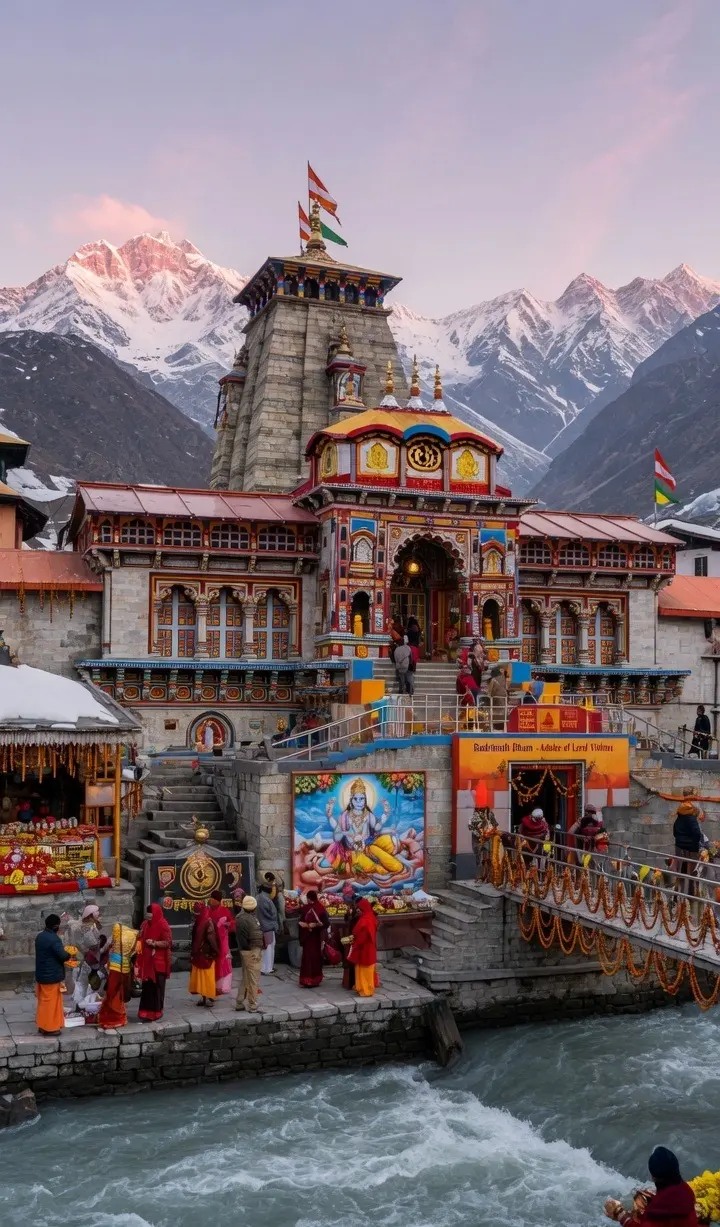
Standing at an elevation of roughly 3,583 meters (11,755 feet) in Uttarakhand's Rudraprayag district along the Mandakini River, Kedarnath Temple is the highest of Shiva's twelve Jyotirlingas and the primary shrine of the Panch Kedar pilgrimage. While Hindu tradition attributes the original shrine to the Pandavas and their grandson King Janamejaya and credits the 8th-century philosopher Adi Shankaracharya with rebuilding or reviving the temple, textual and historical evidence anchors the site's early prominence across the medieval period. The Skanda Purana (c. 7th–8th century) and Tamil Tevaram hymns (6th–7th century) attest to Kedarnath's early sanctity, the Kritya-kalpataru confirms its status as a major pilgrimage center by the 12th century, and writer-historian Rahul Sankrityayan dated the standing edifice to between the 10th and 12th centuries.
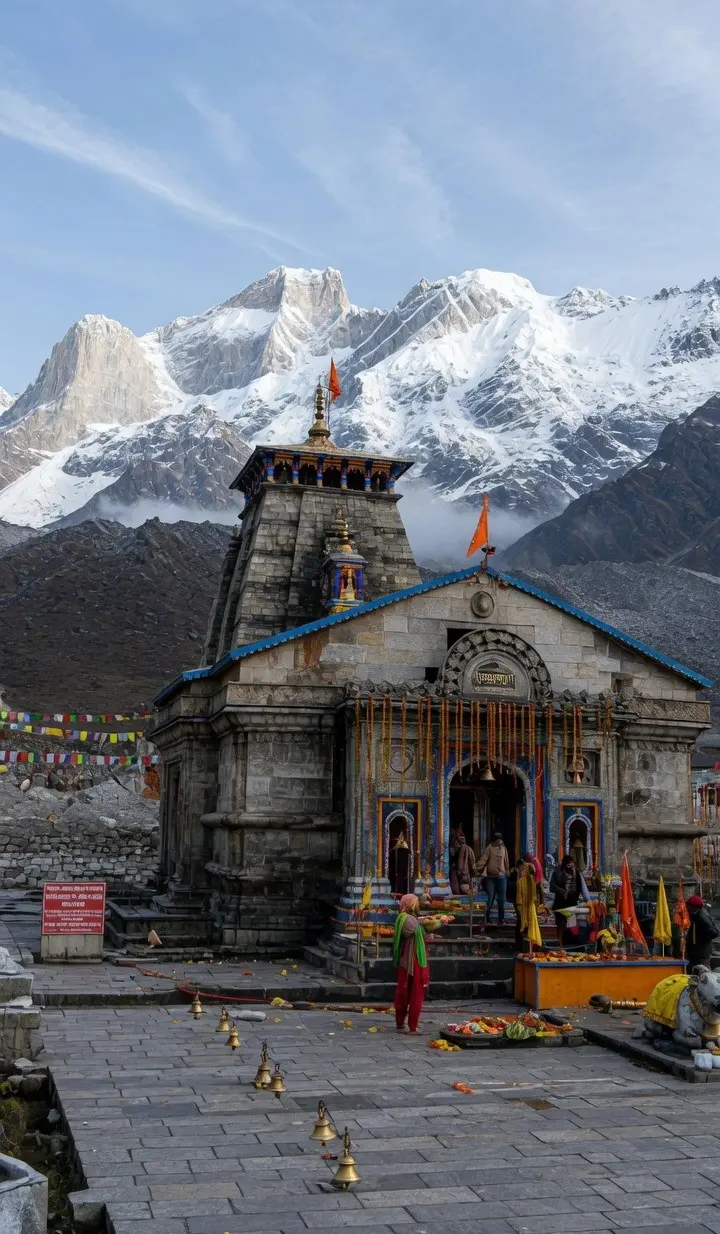
Architecturally, Kedarnath represents the North Indian Nagara style adapted to severe alpine conditions and the regional Katyuri building tradition. Raised on a stone platform reported in regional accounts as roughly 6 feet high the shrine is built from massive, evenly cut grey stone slabs interlocked with iron clamps without mortar. According to press accounts citing geological assessments, the temple remained structurally intact despite roughly 400 years of burial under snow and glaciers during the Little Ice Age (13th–17th centuries). It likewise withstood the June 2013 flash floods, during which a massive boulder later revered as Bhim Shila lodged behind the shrine and deflected the debris flow. Inside, a rectangular pillared mandapa housing sculptures of the Pandavas, Draupadi, Kunti, Krishna, Parvati, and Virabhadra in the hall and approaches leads into a square garbhagriha enshrining a rough, triangular swayambhu (self-manifested) rock worshipped as Shiva's hump in his Sadashiva form.
Although Kedarnath's stone shikhara displays relatively restrained ornamentation compared to many plains Nagara temples, its walls and doorframe carry carved deities, mythological figures, celestial attendants, and floral motifs. Moreover, placing a Kirtimukha above a temple entrance or wall niche aligns closely with regional Himalayan stone architecture. Photographic records document Kirtimukha relief carvings at Dwarahat in Uttarakhand on the panels of the Gurjjar Dev Temple, in a town that also preserves 11th-century Katyuri-built Shiva shrines as well as on stone temple wall niches at the Baseswara Temple in Bajoura, Kullu district, Himachal Pradesh. Because the Kirtimukha became a standard fixture on Nagara sukhanasa gavaksha projections and doorway pediments from the 10th century onward, the visual presence or popular recognition of such a face over Kedarnath's portal fits the broader chronological and regional context of the shrine.
Puranic Origins and Mythology of Kirtimukha
The Sanskrit compound Kīrtimukha literally means "Face of Glory" or "Face of Fame," combining kīrti (glory, fame, or reputation) with mukha (face). Its foundational myth appears in major Puranic texts, notably the Skanda Purana, the Shiva Purana (Rudra Samhita, Yuddha Khanda), and the Padma Purana (Paatal Khanda).
In the Puranic narrative involving Shiva, the asura king Jalandhara, and Rahu, Jalandhara accumulated immense strength through severe austerities and a boon from Shiva, allowing him to terrorize the cosmos and threaten the gods. When divine wrath was provoked described in popular retellings as Lord Shiva opening his third eye in fury a terrifying, insatiable monster burst forth fully formed. As Rahu threw himself on Shiva's mercy and was spared, the ravenous creature, deprived of its prey, turned to Shiva and asked what it should consume next. Shiva commanded, "Devour yourself".
Without hesitation, the creature ate its own limbs and body piece by piece until only its fierce head remained. Moved by this act of absolute obedience and self-offering, Shiva blessed the disembodied head, named it Kirtimukha, and ordained it as the eternal guardian placed above temple thresholds to consume negativity before devotees enter. A separate account in the Padma Purana (Paatal Khanda, Chapter 112, verse 233) reinforces Kirtimukha's reputation as a structural guardian: a wooden lion-face called panchavaktra or Kirtimukha crowned the gopuram of Ravana's citadel in Lanka, and the warriors Atikaya and Mahakaya warned that the city could not fall until Lord Rama shattered that protective face into five pieces with an arrow.
Iconography, Architectural Placement, and Regional Parallels
Across Hindu, Buddhist, and Jain monuments, Kirtimukha is rendered as a fierce, half-human, half-animal mask most commonly lion-faced (simhamukha) engineered visually to command attention at sacred boundaries. Classical sculptures display a consistent anatomical grammar: the mask ordinarily shows only an upper face with protruding fangs and no lower jaw (though rare variants depict clutching arms as well), framed by two bulging eye globes emerging from deep sockets. Two lateral horns and often a third central forehead horn rise above the brow, while swollen cheeks and flared nostrils convey the impression of deep, restrained inhalation (prana) held across the bridge of the nose. Beneath the upper teeth and puffed cheeks, flowing curves representing celestial foam, waves, feathers, flames, and ganas sweep downward into a gavaksha arch; when mythical aquatic makaras anchor the two lower ends of the arch, the composition is termed Kala-makara.
Architecturally, Kirtimukha occupies strategic threshold and apex zones rather than incidental space. Beyond crowning doorways, gateways, and toranas, it appears prominently at the apex of sukhanasa projections and windows, on garbhagriha thresholds flanking a central lotus stalk, atop deity halos (prabhatorana), on cornices, pillars, and ceilings, and occasionally within Shiva's matted locks. Repeated rows of Kirtimukha faces also band temple plinths and bases known as Grasa-pattika in Gujarat and Rahurmukhamala in eastern India or flank entrance steps in South Indian shrines. Early horned precursors appear at Sirkap in Taxila by around the start of the Common Era, advance through Gupta examples such as Nachna Kuthar in Panna, and reach standardized form from the 10th century onward before spreading widely across Asia.
| Region or Tradition | Local Name or Variant | Architectural Context and Visual Form |
| Gujarat (Western India) |
Grasa-pattika |
Continuous horizontal band of Kirtimukha faces along temple bases and socles. |
| Odisha, Bihar, West Bengal |
Rahurmukhamala, Bho, Pancha-vaktra |
Plinth moldings and sukhanasa gavaksha apexes, often paired with a hanging bell in Odisha. |
| Nepal |
Chhepu |
Guardian face above doorways; foliage scrollwork evolved into a crescent on the lion's head after the 7th century CE. |
| Sri Lanka |
Kibini |
Protective guardian motif carved on temple structures. |
| Indonesia and Cambodia |
Kala-Makara, Batara Kala |
Portal and lintel guardian masks, prominently at 9th-century Borobudur and Angkor monuments. |
| China and Korea |
T'ao T'ieh (China); Gamyeon (Korea) |
Ancient monster-mask equivalents (c. 1st millennium BCE in China; from c. 700 CE in Korea). |
| Europe and Mediterranean |
Green Man, Medusa's Mask, Ouroboros |
Foliate church masks (as in English churches and Notre Dame) and self-devouring symbolic parallels. |
Symbolism, Vastu, and Protective Function
Despite its terrifying fangs and bulging eyes, Kirtimukha functions as an auspicious emblem. In Vastu and Tantric traditions, a temple doorway marks the critical boundary where the ordinary, chaotic world transitions into a purified sacred interior. Positioned gazing outward with an open mouth, Kirtimukha serves as a spiritual filter commonly equated in modern popular usage with a nazar battu (evil-eye charm) believed to swallow envy, misfortune, impure intentions, and disruptive energies while stabilizing the energetic integrity of the shrine. Tradition even held that if a temple's Kirtimukha cracked, the structure's spiritual vitality could wane.
At an inner philosophical level, the creature's self-consumption reminds entering devotees that the fiercest demon to overcome is the human ego. Because Kirtimukha surrendered its entire physical form to Shiva's command and was elevated to a permanent crest-jewel above the sanctum path, pilgrims are reminded to surrender pride at the threshold. Art historians such as Heinrich Zimmer have compared this self-devouring motif to the Ouroboros, symbolizing the eternal cycle of creation, destruction, and renewal.
Related Head, Face, and Sanctum Traditions at Kedarnath
Public discussion of the "Kirtimukh of Kedarnath" frequently blends the exterior doorway carving with three separate religious, geographic, or conservation features connected to the shrine. Keeping these distinct prevents common misattributions.
Inside Kedarnath's garbhagriha, the irregular triangular swayambhu lingam itself bears an unusual iconographic feature: a human head carved directly into the triangular stone lingam, a motif mirrored at the nearby Triyuginarayan Temple associated with Shiva and Parvati's celestial wedding. Devotional accounts also note a figure resembling Ganesha and Parvati's Sri Yantra on the front of the sanctum rock. This interior lingam carving is entirely separate from the face positioned above the outer entrance doorway.
Outside the main temple, a distinct "guardian" and "head" geography surrounds Kedarnath. On a ridge overlooking the shrine sits the open-air temple of Bhukund Bhairavnath (Kaal Bhairav), Kedarnath's Kshetrapal (guardian deity), who is revered for protecting the valley during the six winter months when snow closes the main temple and Kedarnath's five-faced (panchamukhi) mobile image is carried down to Omkareshwar Temple in Ukhimath. Further afield in Nepal, Doleshwor Mahadev Temple in Bhaktapur District is revered within Panch Kedar lore as the head portion of the bull-form Kedarnath (while other traditions link the upper torso/head to Pashupatinath in Kathmandu), and Kirtimukh Bhairav is a distinct Bhairava shrine within Kathmandu's Pashupatinath complex. None of these Nepalese shrines refers to the entrance carving in Uttarakhand.
Finally, modern structural conservation and metal-cladding controversies at Kedarnath have focused on the foundation and interior sanctum rather than the outer doorway face. Following the 2013 floods, an IIT-Madras expert team verified that the temple's foundation suffered no damage, and the ASI carried out multi-phase exterior stone conservation. Around Diwali in October 2022, 19 artisans working under the supervision of two ASI officers applied 550 gold sheets donated by Maharashtra's Lakhi family to the interior walls and ceiling of the garbhagriha, alongside a decorative grille and umbrella. That project drew protests from priests over altering historic sanctum surfaces and sparked allegations in June 2023 of a Rs 1.25 billion brass-substitution scam and in July 2024 of 228 kg of missing gold, before a September 2025 state inquiry led by Garhwal Commissioner Vinay Shankar Pandey cleared the Badrinath-Kedarnath Temple Committee of wrongdoing. Throughout those interventions, the exterior stone doorway and the carved face above it remained separate from the gilded interior chamber.
Keep Reading
View All Articles-
The Ajanta Cave Murals: India's Finest Early Buddhist Art
Buddhism found its earliest and most beautiful artistic expression at the Ajanta Caves in Maharashtra, India.
-
Padmanabhaswamy Temple: Mystery of Secret Vault B
Uncover the wealth and mysteries of Kerala's Padmanabhaswamy Temple. Learn about the untouched secret Vault B sealed by ancient Naga Bandham
-
The Great Kailash Temple of Ellora
Deep within the rocky embrace of the Charanandri Hills in Maharashtra, India, lies a monument that challenges the boundaries of human imagination and ancient engineering.