







Scriptural Reasoning
Dhuni Tapa and Other Sadhana in Hindu Traditions
At the core of these practices is the ritual of Dhuni Tapa (the austerity of the fires), which is anchored in the ancient Upanishadic doctrine of Panchagni Vidya
 By Prerak "प्रेरक"
21 min read

The Metaphysical and Upanishadic Foundations of Dhuni Tapa
Within the landscape of South Asian religious traditions, somatic asceticism represents a highly structured system designed to align human consciousness with the cosmic order. At the core of these practices is the ritual of Dhuni Tapa (the austerity of the fires), which is anchored in the ancient Upanishadic doctrine of Panchagni Vidya (the knowledge of the five fires). This teaching is recorded in Chapter V of the Chandogya Upanishad and Chapter VI of the Brihadaranyaka Upanishad. Historically, this knowledge was a closely guarded secret of the warrior class (Kshatriyas). It was first transmitted to the Brahmin caste when the royal sage Pravāhana Jaivali, an expert in the sacred udgitha chanting, taught it to Svetaketu and his father, the sage Uddālaka Āruni.
The teachings of Panchagni Vidya are designed to address the binding, cyclical effects of natural processes (samsara) that arise from an ignorance of universal laws. Indologists contrast the metaphysical approaches of the two major Upanishadic recensions: the Brihadaranyaka Upanishad is characterized as aprapancha (transcendental, focusing on the ultimate Absolute), while the Chandogya Upanishad is saprapancha (leading the practitioner through the empirical world before elevating them to transcendence). Both texts present the universe as an interconnected web of sacrifices (yajnas), illustrating how the individual soul (Atman) is fundamentally non-dual with the Supreme Reality (Brahman).
A central concept in this process is Apurva the unseen, subtle potential generated by ritual action that shapes future experience. In his commentary on Sloka IX.80 of the Panchadasi, the scholar Swāhānanda notes that while spiritual knowledge, once realized, is irreversible, meditative contemplation (vidya) remains dependent on the active will of the practitioner. In the Brahma Sutras, the sage Badarayana addresses the consistency of these meditations across different traditions, stating that the core practice remains the same despite minor differences in expression. Commenting on this, the philosopher Adi Shankara explains that this essential unity persists even when some traditions include a sixth fire in the five-fire framework.
This cosmic cycle is also reflected in classical Hindu epics and mythologies. For example, in the Ramayana, Sita's fire ordeal (Agni Pariksha) is interpreted as an allegory for mastering the ten senses represented by the ten heads of the demon Ravana which bind human consciousness to lower energy centers. Fire (agni) serves as the catalyst that dissolves the individual ego, transforming it into a state of unified, self-effulgent awareness. This is further illustrated by Hanuman, who crosses earth (prithvi) and water (apas) to locate Sita, and then uses the fire of his own austerities (tapas) to set Lanka ablaze. Similarly, in the Katha Upanishad, Lord Yama (the deity of death) instructs the young Nachiketas in the mysteries of the sacred heavenly fire as the path of light and liberation.
The Alchemical Structure of Panchagni Tapasya: Mechanics and Stages
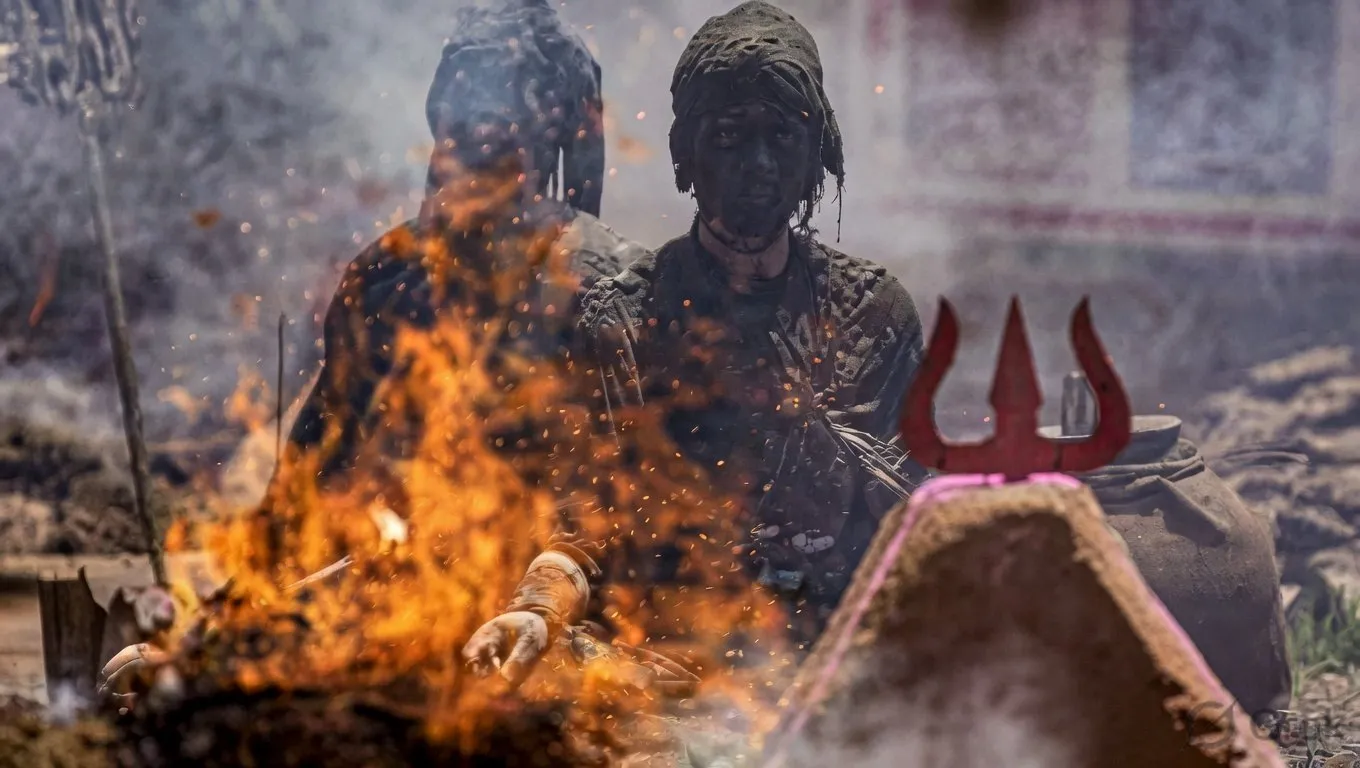
While Panchagni Vidya originated as a contemplation on the five cosmic fires, ascetic lineages particularly the Ramanandi Tyagis and various Shaiva Akharas translated this doctrine into a physical penance known as Dhuni Tapa or Panch Dhuni Tapasya. This somatic practice is strictly observed during Uttarayan (the northern run of the sun from mid-January's Makar Sankranti to mid-July's Karka Sankranti). This period represents the path of light and liberation (Devayana), contrasting with the southern path (Pitriyana), which binds the soul to the cycle of rebirth.
|
Upanishadic Fire |
Physical/Macrocosmic Form |
Sacrificial Offering |
Resulting Output |
Symbolic Elements and Altar Layout |
|
First Fire |
Heaven (Svarga) |
Faith (Shraddha) |
Nectar (Soma Raja) |
Sun acts as fuel; daylight is the flame; moon is the coal; stars are sparks. |
|
Second Fire |
Rain God (Parjanya) |
Soma Raja |
Rain |
Year is the fuel; clouds are smoke; lightning is the flame; thunderbolts are embers. |
|
Third Fire |
Earth (Prithvi) |
Rain |
Food |
Year is the fire; sky is smoke; night is the flame; directions are charcoal and sparks. |
|
Fourth Fire |
Male Body (Man) |
Food |
Seminal Fluid / Seed |
Speech is fire; prana is smoke; tongue is the flame; eyes are coal; ears are sparks. |
|
Fifth Fire |
Female Body (Woman) |
Seminal Fluid |
New Life (Embryo) |
Sexual union represents the coal; small pleasures are the sparks of creation. |
The physical practice of Dhuni Tapa is a multi-year discipline that tests the limits of physiological endurance. Under the guidance of a spiritual master, the ascetic systematically builds tolerance to extreme heat :
- Year 1: The ascetic sits before a single fire for six months, lighting all five fires only on the full moon (Poornima) and new moon (Amavasya).
- Year 2: The practitioner sits before two active fires daily, lighting all five during the key phases of the moon.
- Years 3–5: An additional fire is added to the daily practice each year.
- Year 6: The ascetic performs the complete austerity, sitting in the center of all five fires daily for an entire year.
- Subsequent Years: The external fires are transferred to a consecrated, interior altar. The fire is covered with sacred ash (bhasma) but kept smoldering inside.
This transition marks the shift from physical endurance to the mastery of the five internal fires: kama (passion), krodha (anger), lobha (greed), moha (attachment), and matsara (jealousy). This phase is known as the Pashupati vrata, a vow undertaken to master the instinctual, animalistic nature of the ego.
▲
│
◄──── Meditator (Center) ────► [East: Chandra Agni (Moon Fire)]
│
▼
In structured monastic settings, such as the Alakhpuriji Siddha Peeth tradition, the five fireplaces (dhunis) are arranged in a precise circle to represent specific cosmic forces :
- North (Surya Agni): Represents spiritual knowledge and vital energy.
- East (Chandra Agni): Channels a cooling, balancing energy to soothe the mind and emotions amidst intense heat.
- South (Agni Kona): Corresponds to the Manipura Chakra (the navel plexus), regulating body warmth and burning away negative karma.
- West (Guru Agni): Represents the guidance of the spiritual master (Satguru).
- Center/Upward (Ishana): Represents Divine Truth, uniting the local elements with the sun.
The daily liturgy of the ritual begins with purification prayers led by pandits, who smear the ascetic's body with sacred ash (bhasma). The ascetic then sits motionless in the lotus position (Padmasana) at the center of the fires, entering a state of deep meditation. At the end of the session, pandits use purifying salts to gently guide the ascetic back to normal consciousness.
In the advanced stages of this practice (often in the sixteenth season), the ascetic may perform Kapar Dhuni, placing a burning clay bowl (kapar) directly upon their shaven head or skull (kapar). Throughout these sessions, the ascetic uses traditional tools, such as iron tongs (chimtas) to manage the glowing cow dung cakes, brass water pots (kamandals) for purification, and a conch shell (shankh) to invoke the deities.
Somatic Penances of Hatha Yoga: Khareshwari, Urdhvabahu, and Thermal Extremes
Hatha yogis perform a variety of demanding physical penances (tapasya) to transcend physical limitations and quiet the mind. Among these, Khareshwari (the standing penance) is a vow where the practitioner remains upright at all times, refusing to sit or lie down even to sleep, often for a period of twelve years.
To sustain this posture, the ascetic utilizes a specialized swing-like support suspended from a tree or inside a temple courtyard. This swing features a chest-high padded bar or rope upon which the ascetic can rest their arms and torso during the day, and lean their weight to sleep at night. A hanging sling beneath the swing supports one leg at a time, allowing the practitioner to alternate weight and relieve tension in their feet.
┌──────────────────────────┐
│ Overhead Support Beam │
└─────────────┬────────────┘
│
┌─────────────┴────────────┐
│ Upper Padded Swing │ ◄─── Supports Arms & Torso
└─────────────┬────────────┘
│
┌─────────────┴────────────┐
│ Lower Hanging Sling │ ◄─── Alternates Leg Support
└──────────────────────────┘
The initial stages of this penance cause severe swelling, fluid retention, and ulcerated feet. However, orthopedic studies of long-term practitioners note that the body eventually adapts. Over time, joint calcification and neurological adaptation lead to numbness, causing the physical discomfort to subside as the practitioner enters deep states of meditative focus.
An example of this discipline is Naga Swami Bhagirathi Giri of the Atal Akhara, who completed a twelve-year standing penance and then initiated a three-year standing penance on a single leg. Similarly, the Russian-born yogini Sadhvi Annapurna Nath of the Nath Sampradaya performed Khareshwari during consecutive Navratri festivals at the Jaipur Ghat of Pushkar Lake under the guidance of Yogi Deepak Nath, sustaining her physical energy on a single meal of fruit each day.
Another demanding discipline is Urdhvabahu, where the practitioner keeps one arm raised continuously toward the sky. Over several years, this posture leads to permanent physiological changes: the joints calcify, the muscles atrophy, and the hand becomes shrunken and stiff, resembling a dry piece of wood with overgrown, curled nails. Ascetics like Mahant Radhe Puri of the Juna Akhara (who has kept his right arm raised since 2011) and Mahant Mahakal Giri of the Aawahan Akhara (who kept his left hand raised for nine years) maintain this posture continuously whether awake, asleep, or traveling—as an offering for global peace and the preservation of dharma.
In contrast to fire and standing penances, some ascetics perform thermal water penances (Jal Tap or Jaldhara) during the coldest winter months. This includes practices like Jaldhara, where a continuous stream of cold water is directed onto the head of the seated practitioner to maintain mental focus.
Another form is the pitcher penance practiced by Naga Baba Pramod Giri of the Atal Akhara. During the freezing early morning hours, the ascetic bathes with multiple pitchers of cold river water. This penance begins with 51 pots of water daily and increases incrementally to 108 pots over a 24-day cycle, serving as a test of physical and mental endurance.
Comparative Rituals and Liturgies of the Monastic Sampradayas
The diverse ascetic practices of Hinduism are organized and preserved within three primary monastic lineages: the Shaiva, the Vaishnava, and the Nath Sampradayas. Each has its own distinct initiation ceremonies, codes of conduct, and ritual guidelines.
Shaiva Akharas and the Naga Sadhu Initiation
The Shaiva monastic orders are organized into akharas (monastic sects) originally established by Adi Shankaracharya to safeguard Sanatan Dharma. The seven major Shaiva Akharas—Juna (the largest), Mahanirvani, Niranjani, Atal, Anand, Awahan, and Agni—are renowned for their Naga Sadhus (warrior-ascetics).
Becoming a recognized Naga Sadhu is a demanding process that often requires twelve years of preparation, study, and service under a guru. The candidate progresses through three distinct stages :
- Mahapurush (Novitiate): The candidate observes strict celibacy (Brahmacharya) and serves the senior monks within the akhara for at least six years.
- Advhoot: The candidate detaches from worldly identities, family ties, and personal possessions.
- Naga (Initiation): The final test takes place during major religious gatherings like the Kumbh Mela.
The final initiation ritual is a symbolic transition where the candidate leaves behind their worldly life and is "reborn" into the monastic order.
The candidate first receives permission from their guru to undergo the Mundan Sanskar (tonsuring of the head) on the riverbank, followed by a ceremonial bath and receiving the Janeu (sacred thread). The most significant ritual is the performance of Pind Daan. The initiate offers funeral cakes (pinda) to the departed souls of seven future and seven past generations, and then performs their own final death rites (Pind Daan and Mukhagni). This ritual legally and socially marks the candidate's death to the worldly sphere.
Following this, the initiate discards all garments and walks seven steps naked to symbolize cutting off social conditioning and shame. Under the Dharma Dhwaj (the banner of eternal truth), the Acharya Mahamandaleshwar administers the Ahuti Diksha and imparts the sacred Giyatri or sectarian mantras.
The new Naga has their body smeared with sacred ash (vibhuti or bhasma), which serves as spiritual protection and physical defense against the elements. They are presented with traditional weapons—a trident (trishul) or sword and items like a rudraksha rosary, a damaru drum, and a water pot (kamandalu). The initiation concludes with the Amrit Snan (royal bath), taking 108 dips in the sacred river to complete the process.
A unique subset within the Shaiva lineage is the Aghori sect. Unlike standard Nagas, Aghoris practice extreme tantric rituals, often meditating in cremation grounds and utilizing human skulls (kapala) as ritual bowls. Their practices emphasize radical non-duality, viewing all aspects of creation as equally sacred and rejecting societal distinctions between pure and impure.
Vaishnava Bairagis and the Pancha Samskara
The Vaishnava ascetics, known as Bairagis (those detached from the world), belong to the Ani Akharas (primarily the Nirvani, Digambar, and Nirmohi sects). They follow the path of devotion (bhakti) and are dedicated to Lord Vishnu and his avatars, Rama and Krishna.
The Bairagis of Hanuman Garhi in Ayodhya adhere to strict lifestyle rules. They wear white, unstitched clothing, carry a kamandal, sport a sacred tuft of hair (shikha), and wear necklaces of Tulsi beads. They also carry a symbolic bow and arrow tattoo on their arm as a sign of their tradition. Their monastic structure is organized into three military-style divisions: the Digamber as "Raja" (king), the Nirmohi as "Mantri" (commander), and the Nirvani as "Sena" (army).
The primary initiation process in Vaishnavism is the Pancha Samskara (five purificatory sacraments), which is considered essential to qualify a devotee to worship Vishnu. Established by teachers like Ramanujacharya and Madhvacharya, these five sacraments are :
- Tapa (Repentance and Branding): To sanctify the physical body, the guru brands the initiate's shoulder blades with heated metal stamps containing the symbols of Vishnu's weapons: the conch (unkha) on the left and the discus (chakra) on the right. In some traditions, such as the Gaudiya Vaishnava lineage, physical branding is replaced by printing these symbols using sandalwood paste or clay, in accordance with teachings for the current era.
- Pundra (Sacred Markings): The initiate is taught to apply vertical clay markings (urdhva-pundra or tilaka) to twelve parts of the body. These markings represent the temple or footprints of Vishnu, symbolizing spiritual focus and the path of advancement (urdhva-gati).
- Nama (The Devotional Name): The initiate is given a new name ending in Dasa (servant) or Dasi (handmaid) to signify their new identity and commitment to divine service.
- Mantra (The Sacred Prayer): The guru whispers sectarian mantras, such as the Gopal mantra or the Ashtakshara (Om Namo Narayanaya), into the disciple's ear to initiate their personal spiritual practice.
- Yaga (Deity Worship): The disciple is instructed in the daily rituals of deity worship (sri murti or salagrama sila puja), engaging their physical senses in service.
Nath Sampradaya and the Kanphata Liturgy
The Nath Sampradaya, founded by Matsyendranatha and systematically organized by Gorakhnath in the 9th to 10th centuries, emphasizes the practice of Hatha Yoga and inner energy awakening (Kundalini). The most distinctive ritual of this order is the ear-piercing ceremony that designates the Kanphata (split-eared) yogis.
During this initiation, the guru uses a double-edged knife to split the central cartilage of the initiate's ears. Large rings made of clay, glass, or stone, known as kundal or mudra, are inserted into the openings. According to Nath teachings, splitting this cartilage stimulates key energetic meridians (nadis), facilitating sensory control, emotional steadiness (santokha), and the flow of yogic energy.
Within the Nath tradition, there are four legendary origins of this practice:
- Shiva's own ascetic wear.
- Matsyendranatha's initiation ceremony.
- Bhartri's plea to Jalandharanatha for a distinguishing mark, resulting in clay rings.
- Shiva ordering Parvati to split Gorakhnath's ears.
In the Japu, Guru Nanak provides a spiritual reinterpretation of these symbols, explaining that true mudra represents inner contentment (santokha), truth (sat), and luminous knowledge (gian) rather than merely external adornment.
The principal seat of this lineage is the Gorakhnath Temple in Gorakhpur, which hosts the annual Khichdi Mela during Makar Sankranti. During this event, the head of the lineage (Gorakshpeethadheeshwar) leads the ritual offering of khichdi (a mix of rice and lentils) into the sacred vessel (khappar) of Mahayogi Guru Gorakhnath. This is followed by a traditional offering sent by the royal family of Nepal, reflecting the historical ties of the Nath lineage to the region.
Vratas, Austerities, and Everyday Rituals of Sadhus
The daily life of a Hindu ascetic is structured around self-discipline and sensory restraint. Central to this lifestyle are vratas (vows or daily restrictions) undertaken for a specific duration to foster detachment from physical desires. Common vows include regular fasting, celibacy, and maintaining silence (mauna), which are designed to quiet the mind and conserve spiritual energy.
On the spiritual path, practitioners make a clear distinction between individual effort (tapasya) and divine association (satsang). This is illustrated by the story of Vishwamitra and Vashishtha. Although Vishwamitra performed intense physical penances, he only achieved true transformation and became a Brahmarishi when his ego dissolved through satsang and humility. Thus, while tapasya represents individual effort that purifies through discipline, satsang represents divine association that helps dissolve the ego.
│
┌─────────────────────────┴─────────────────────────┐
▼ ▼
Generates inner heat; purifies Dissolves the ego;
the mind and body. reveals ultimate truth.
Daily life also includes everyday somatic choices, such as walking barefoot, sleeping on the bare ground, and maintaining specific dietary restrictions. Many ascetics follow strict food disciplines :
- Phalahari Sadhus: Restrict their diet strictly to fruits and certain root vegetables.
- Payahari Sadhus: Consume only milk, rejecting all solid food.
A specific example of a structured vow is the Candra vrata (moon vow) practiced by ascetics like Balyogi Murali Das on Mount Abu. This vow is a form of purification aligned with the lunar calendar. The practitioner begins by eating a single Tulsi leaf, increases the intake to fifteen leaves by the full moon (Poornima), and then decreases the intake back to zero by the new moon (Amavasya), consuming only dried fruits during this period to purify the body and mind.
For Vaishnava ascetics, daily life follows a consistent routine from early morning to evening :
|
Time Period |
Liturgical Activity |
Core Practice and Spiritual Significance |
|
Brahma Muhurta (4:00 AM – 6:00 AM) |
Snana & Sandhya |
Sacred bathing, applying tilak, and performing sandhyavandanam and japa. |
|
Morning |
Thakur Seva |
Invoking the deity through mangala arati, abhishek, and offering bhog. |
|
Midday |
Svadhyaya |
Studying and reciting sacred texts like the Gita or Ramcharitmanas. |
|
Evening |
Satsanga & Arati |
Participating in communal prayers, singing kirtans, and distributing prasadam. |
For some ascetics, this daily schedule is balanced with physical training. At places like Hanuman Garhi in Ayodhya, some Bairagis maintain a dual routine of spiritual practice and traditional wrestling. Their schedule includes rising at dawn, bathing in the Sarayu River, performing their morning prayers, practicing wrestling techniques in the local training ground, and maintaining a simple, high-energy diet.
Post-Mortem and Transcendent Samadhi Liturgies
In Hindu ascetic traditions, the transition of an advanced yogi or saint out of their physical body is governed by unique practices that differ from standard lay funeral customs. Rather than being cremated, advanced souls are interred through Samadhi rituals, as they are believed to have already purified their physical bodies through the "fire of yoga" during their lifetime.
Bhu Samadhi (Inhumation)
Bhu Samadhi is the earth interment of an advanced ascetic. The ritual is conducted according to monastic guidelines (Yati Aradhana) :
- Preparation: The ascetic's body is washed, adorned with sectarian markings (tilaka), and placed in a seated meditation posture (such as Padmasana).
- The Pit: A deep, square shaft is dug in the ground, often featuring a small niche facing a sacred direction.
- Placement: The seated body is lowered into the pit, with a marker rod extending to ground level to identify the exact position of the head.
- Layering: The space around the body is carefully filled with layers of natural, purifying substances: large quantities of salt, sacred ash (vibhuti), sand, turmeric, sandalwood powder, cow dung, and charcoal. These materials naturally preserve the remains while maintaining the sanctity of the site.
- Adhishtanam: A shrine is built over the interment site, with a Shivalinga installed to serve as a focus for ongoing worship and remembrance.
Jal Samadhi (Water Immersion) and the Ecological Shift
Historically, Jal Samadhi the immersion of an ascetic's body in a sacred river like the Ganga or Yamuna was a common practice. This custom is rooted in the tradition of Lord Rama's immersion in the Sarayu River, signifying a peaceful return to the primal waters. The practice was also associated with the sanyasi's vow to serve others even in death, allowing their physical remains to serve as food for aquatic life.
However, this custom has faced challenges in recent decades due to environmental concerns, decreasing river flow, and the impact on communities downstream. Consequently, major monastic bodies, including the All India Akhara Parishad and the Udasin Panchayati Akhara, have made formal decisions to transition away from Jal Samadhi. These lineages now advocate for Bhu Samadhi or standard cremation (Agni Sanskar), provided local authorities designate sufficient land for monastic burial grounds.
Sanjivan Samadhi (Conscious Meditative Departure)
Sanjivan Samadhi (or Jivan Samadhi) represents a unique and highly revered transition, where an advanced master consciously enters an underground tomb while in a state of deep meditation to depart the physical world.
Unlike post-mortem burials, the yogi voluntarily enters the tomb, sits in deep meditation, and allows their breath to cease naturally. Devotees believe that these masters remain in an immortal, meditative state at the threshold of life and death, continuing to project spiritual guidance to the world.
Prominent historical examples of this transition include:
- Saint Dnyaneshwar (Jnaneshwar): In the 13th century, this prominent Varkari saint took Sanjivan Samadhi at Alandi in Maharashtra. His shrine remains a major pilgrimage site, with the local tradition maintaining that he remains present in deep meditation beneath the altar.
- Moraya Gosavi: A prominent 14th-century saint of the Ganapatya tradition who took Sanjivan Samadhi at Chinchwad, leaving behind his physical body to merge fully with the divine.
Keep Reading
View All Articles-
Hindu Mythology: Celestial Beings & Sacred Deities
Explore the hierarchy of celestial beings in Hindu texts, including the 12 Adityas, 8 Vasus, 11 Rudras, Yakshas, Gandharvas, and Apsaras
-
Ayurveda Mind-Body Connection: Sutrasthana
Discover Ashtanga Hridayam Sutrasthana Chapter 1. Learn how Ayurveda links mental stress, jealousy, and anxiety to physical chronic illness.
-
Goddess Kaalratri: The Fierce 7th Form of Navdurga
Maa Kaalratri is the seventh form of Goddess Durga and is worshipped on the seventh day of Navratri. Known as the destroyer of fear, negativity, evil forces, and obstacles, she is a powerful divine form associated with courage, protection, and spiritual awakening.